As a professional magician, Travis Kim has been doing magic tricks for the past 10 years. Now, as a Seattle Academy teacher, he incorporates his magic into the classroom to teach students how he applies the principles of mathematics into his trickery.
"Isosceles triangle – you make one every time you make a house of cards," explains Travis, who teaches both eighth- and ninth-grade math. "I've also used the Pythagorean Theorem to determine the dimensions of a magic prop." Travis is constantly asking himself, "How can math help me create magic?"
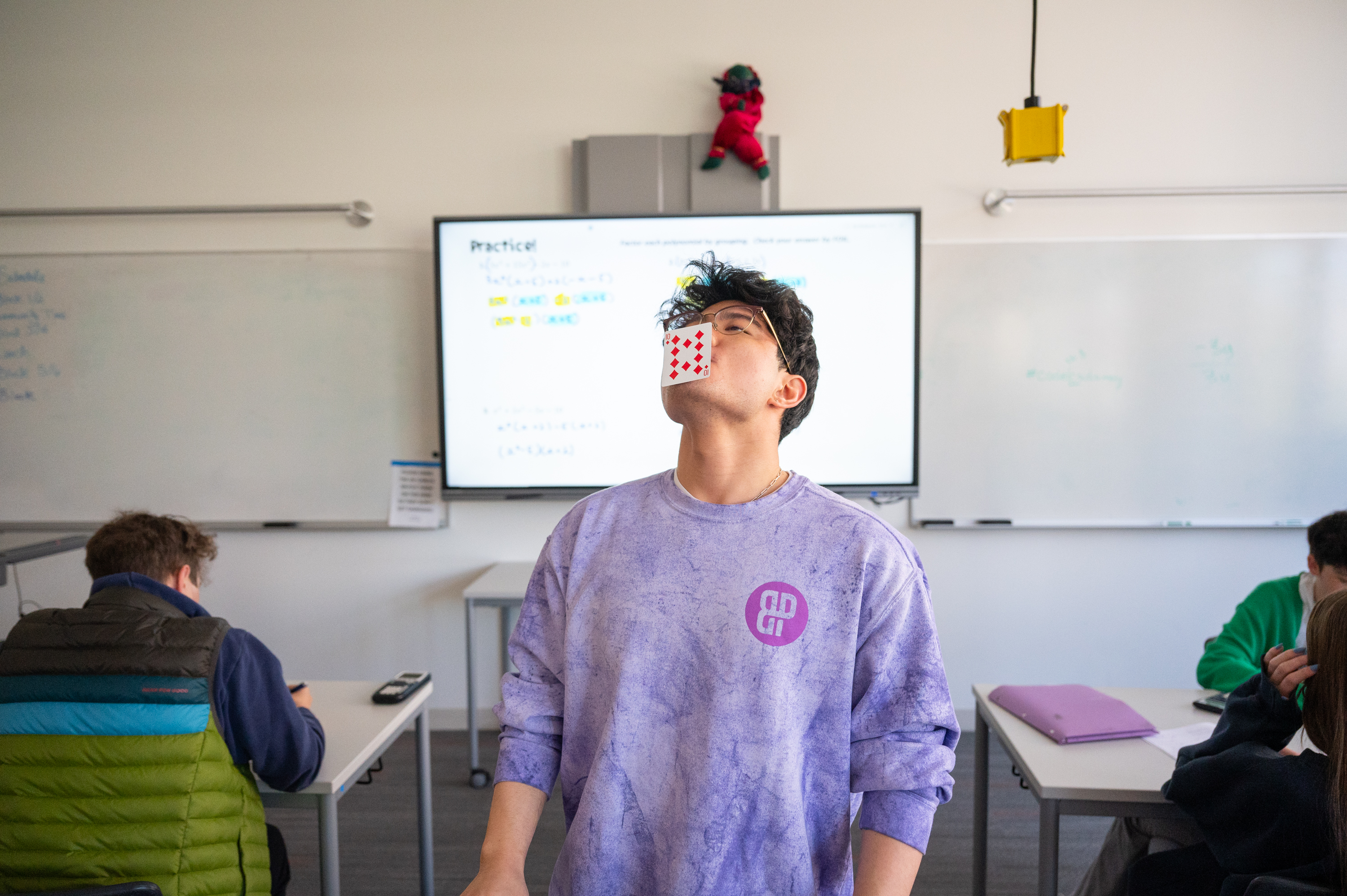
In his class, he focuses on how to use magic tricks to engage students in math problems. "When I think of my role as a magician and doing magic shows for audiences, I think of my role as a math teacher the same way. It's my job to make either the lesson, or the show, engaging for the audience. They are both performative in that sense," he explains.
"More often than not, being a teacher is like doing a magic show," jokes Travis, "except the audience members heckle me more than usual."
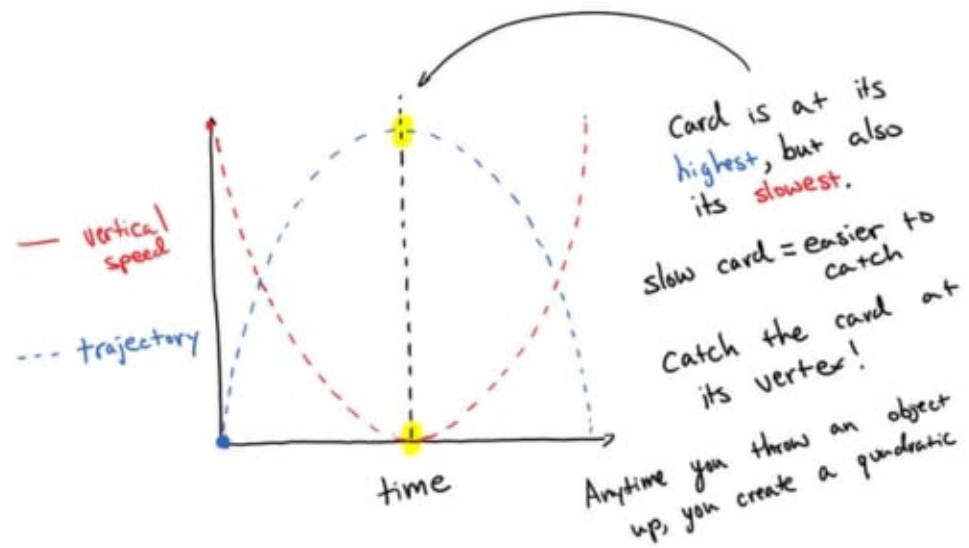
Last month, Travis shuffled a deck at the beginning of class, shooting a card into the air and catching it with his mouth. For the rest of class, Travis explained to students how parabolas made this trick possible. Drawing a basic parabola, Travis challenged students to think of the graph of the card's speed, which resulted in a parabola. The students also observed that the card's trajectory created a parabola itself.
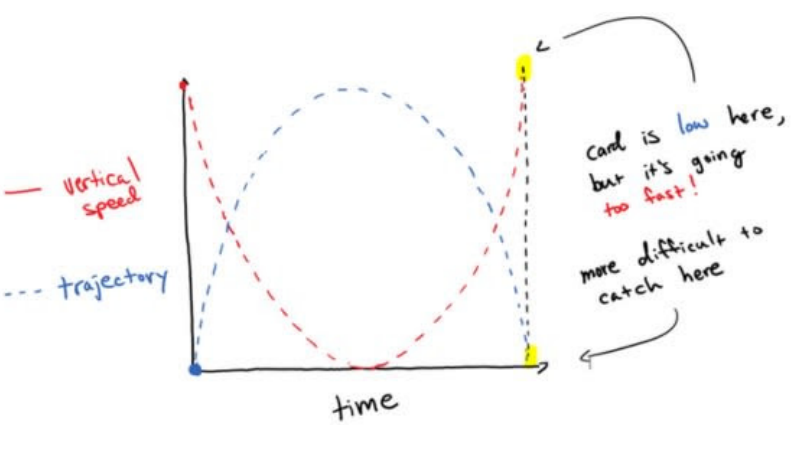
Travis showed how catching the card with his mouth when the card was falling was unsuccessful. Looking at the parabola graph, this is when speed is at its highest. Travis then attempted to catch the card when its speed was closer to zero. He lowered his hand, therefore lowering the launch height, to get closer to the vertex. When doing so, his success increased and it became a much more consistent trick.
"I think this card trick is fun, and I hope one day students look at something getting thrown in the air and see the relevancy of math, or at least have a better appreciation for it."
Magic helps put a visual context to math. Every math teacher will get the question: "When will I ever use this in my real life?" Travis's answer is, "Often, you won't. That doesn't mean it's not a great tool for problem-solving, understanding a new concept or being comfortable not knowing how to solve a problem."
"In magic shows, sometimes I mess up. I mess up more often than people may think," says Travis. "The beauty is the audience has no idea what the magic trick will be. Simply put: things go awry and when I teach math, sometimes I make mistakes. Or a student will correct me. Sometimes lesson plans don't go according to plan."
This is something Travis hopes to teach his students: to feel more comfortable making mistakes.
"When you are dealing with a particular math problem, it's not always clear what the method is to get you the solution you are looking for. I find students are sometimes nervous about that part. They are not always comfortable with not immediately knowing how to do something or making mistakes. I try to encourage mistakes. If students make mistakes, I usually ask them to share with the class if they are comfortable."
"Even if a student doesn't become a mathematician, math can help students get comfortable with not knowing how to solve something on the onset. It can help with problem-solving capabilities and how to think better in general."
Travis is a professional magician when he is not teaching math. He learned his first card trick 10 years ago as a result of a bad skateboarding accident in college that required a long recovery. Magic kept him occupied until he could return to school and show his friends, a rush that kept him going through a physically hard time. He started practicing professionally about five years ago, and has performed at renowned venues including The Magic Castle in the Hollywood district of Los Angeles, California.